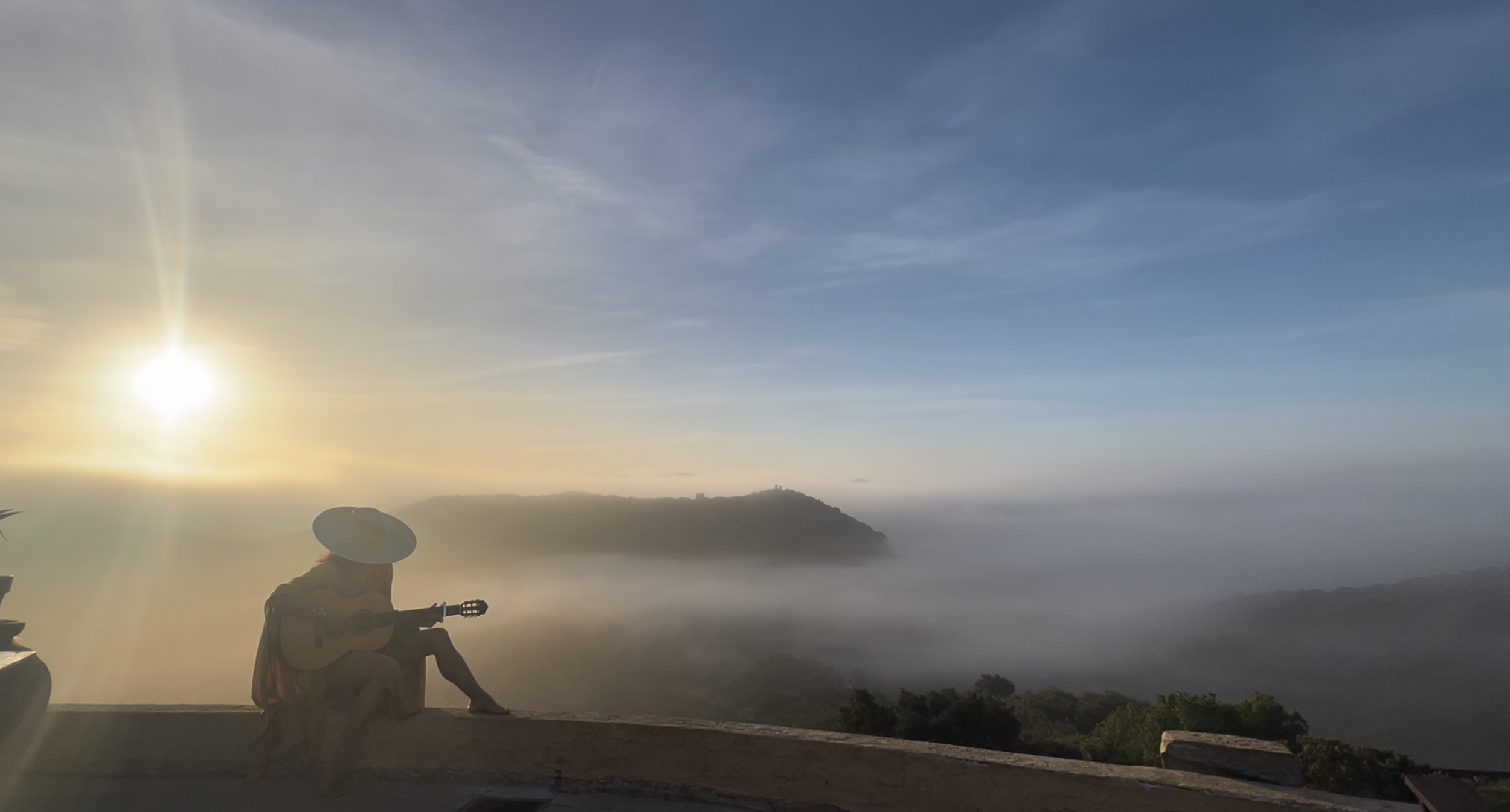
Keep Music Human:
Music Training for Psychedelic Practitioners and Patients of Legal Psychedelic Care.
Twelve weeks of harp or guitar and voice, for people who hold legal psychedelic sessions and for people who want to sit in one with music of their own. You can start with nothing. You finish with music you made yourself, for the weeks before, for the session, and for the long walk home afterward.
Keep Music Human · for legal psychedelic sessions
Twelve weeks · Fifteen seats · Begins March 3, 2027 · Wednesdays on Zoom · Harp, Guitar, or Both
There is always music playing.
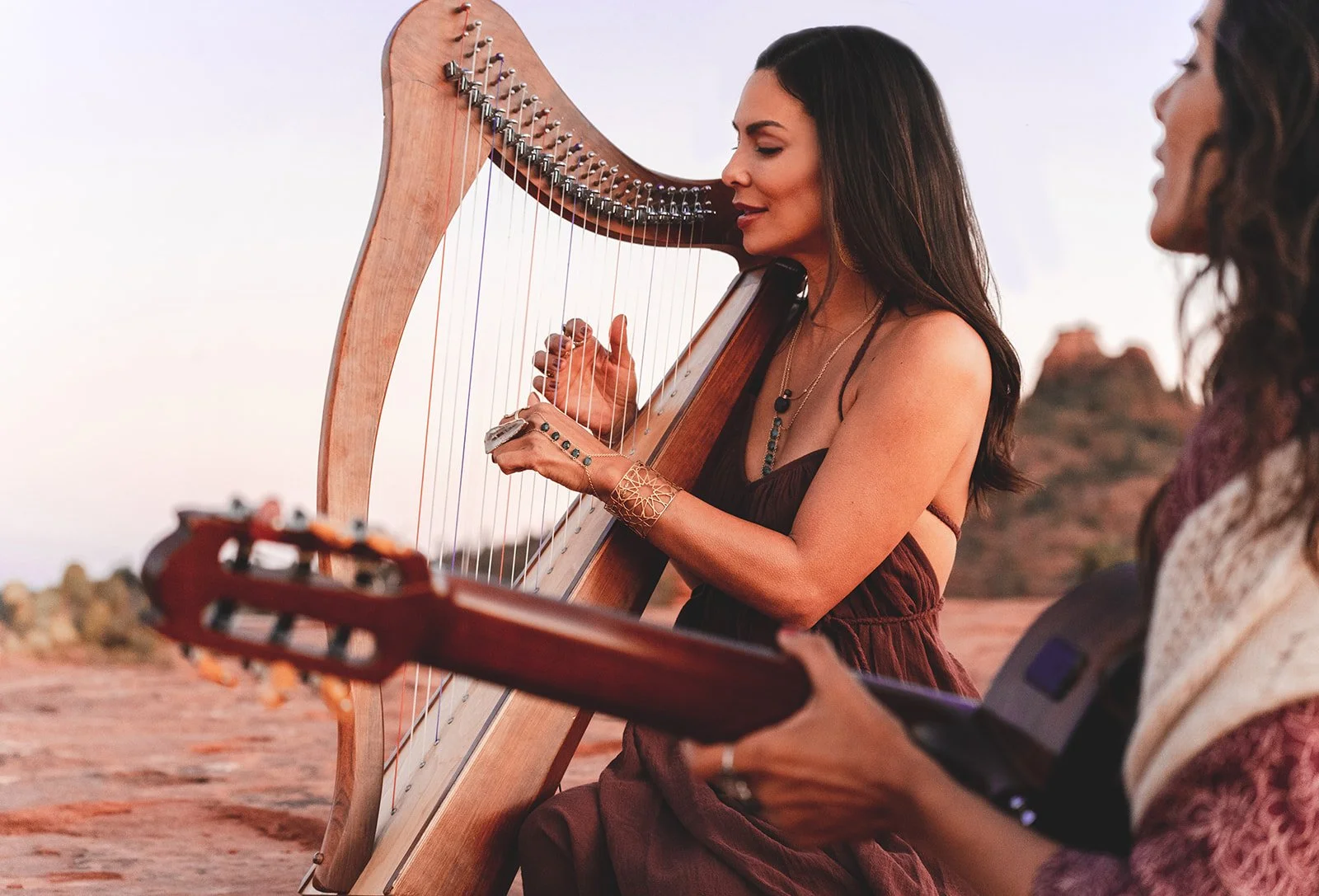
Every psychedelic session I have ever heard of had music in it. The clinical trials that made psilocybin legal ran on playlists. Somebody chose those songs months ahead of time, in an office, for a person they would never meet.
I understand why. It is practical. I think we can do better than practical.
I have spent years in ceremony with people who sing the medicine. In the forest, nobody presses play. Somebody sits beside you and sings, and when you start to cry, the song changes. Humans have done it this way for thousands of years. It has simply never been taught to the people now holding legal sessions in Oregon, Colorado, and soon New Mexico.
So that is what I teach. Creating music. Being music. Letting the divine life of music move through you, and communing with the technology of plant intelligence through song. .
Two kinds of people come to this.
The first holds sessions. A licensed facilitator in Oregon or Colorado. A clinician in New Mexico once that program opens. A therapist in a ketamine clinic, a guide at a retreat in Jamaica, the nurse or chaplain in the next chair. You already choose the music, and you have probably noticed that a playlist cannot hear the person in front of you. You want to be able to pick up an instrument and answer what is happening, in the moment, with your own hands and your own voice. If you are still in facilitator training, your coursework covers screening, safety, ethics, and integration. The music is left to you. That part is what I teach.
The second wants to sit in a session. Maybe you have one booked. Maybe you already sit in ceremony somewhere it is lawful. Either way, something in you wants to sing, or wants an instrument under your hands when the experience gets big. I will say this plainly: playing and singing inside an experience like that is one of the most transformative things I have done in my life, and I have watched it do the same for my students, over and over. You want music that is yours. Something to practice in the weeks before. Something to offer during the session, where the setting allows it. Something to come back to in the months after, when you are trying to keep what you found.
You do not need any experience. Most of my students start from nothing.
One note on words. The licensed programs call it an administration session, so on this page I say session. In the forest with the Yawanawá and Huni Kuin, and in Jamaica with my Rastafari family, it is ceremony. The music does the same work in both.
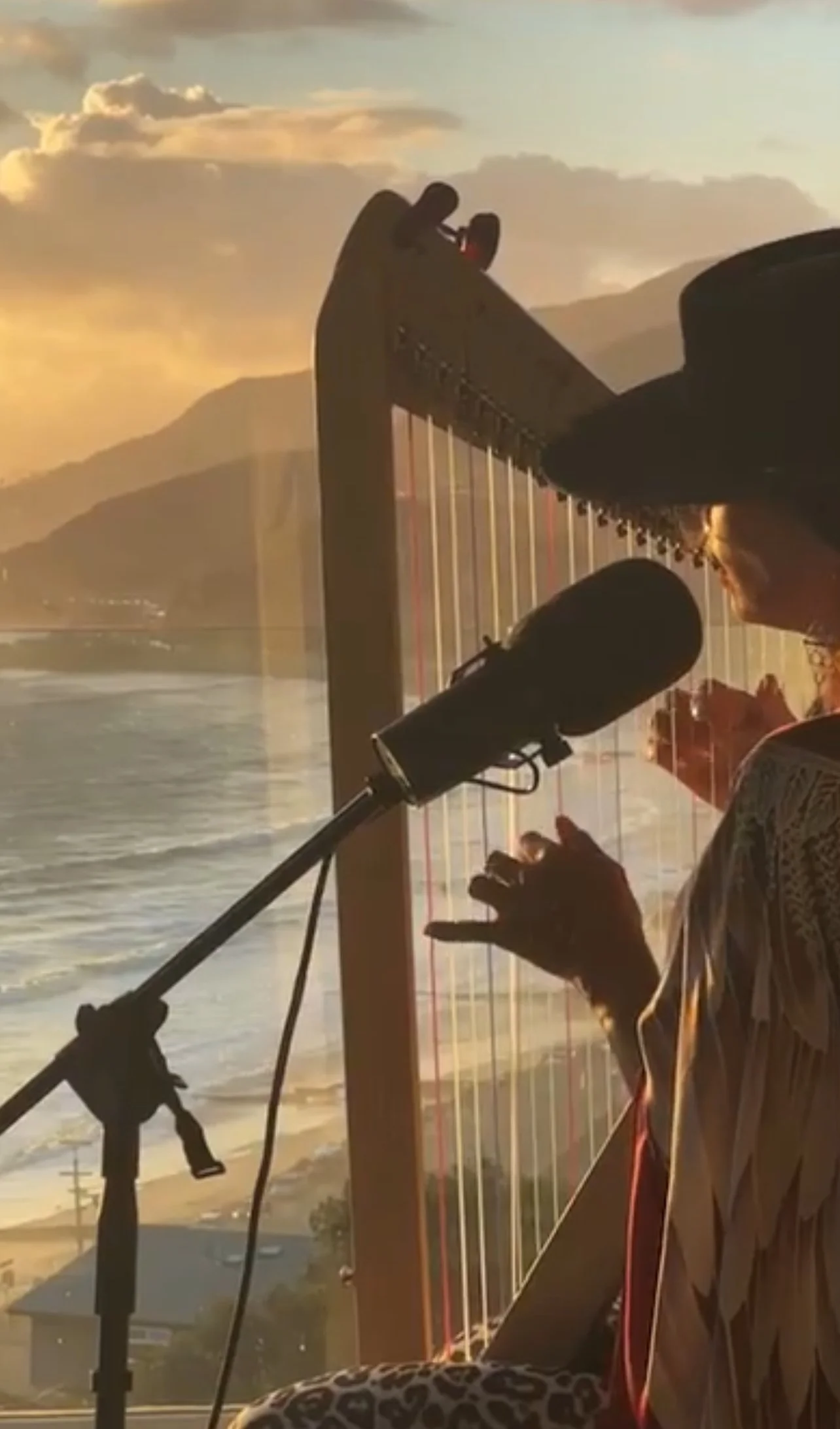
Twelve weeks. Here is what we do with them.
- You pick harp or guitar and make a real sound on the first day. How to hold it, how to tune it, how to draw something beautiful out of it before you know a single chord name.
- You find your voice. Humming first, then toning, then simple songs, until you trust it enough to be heard.
- You learn the handful of patterns underneath nearly every song, through your body, so you can move freely inside them.
- You learn songs early and theory as you need it, which is the order that makes it stick.
- You learn music for the shape of a journey: how to play someone in, what to do in the deep middle, how to bring them home. Repetition, space, and silence as real choices.
- You learn to play for one person. Following their breath. Knowing when to stop.
- You build a daily practice you can use before a session and lean on after one.
The Schedule
Your twelve weeks, mapped.
Ten live classes over Zoom, a Song Circle where everyone plays, and a final week held in reserve. Here's exactly how the season unfolds.
01 · VIA ZOOM
Twelve-Week Music Program
One live 75-minute class and one 30-minute recorded theory lesson each week. Start from zero and build a real foundation on your instrument.
02 · VIA ZOOM
Song Circle
The whole group gathers to play for each other and hear how far everyone has come.
03 · VIA ZOOM
Closing Week
Held in reserve so nobody misses a class, and we close the twelve weeks together.
How we got here.
I want to lay this out, because most people assume psychedelics went from illegal to legal on a vibe. They did not. A small group of researchers, mostly at Johns Hopkins and Imperial College London, spent twenty years running careful trials, and the results kept holding up. This is the trail.
So no, nothing has full FDA approval yet. The states did not wait for it, and the next section shows where.
Music is the hidden therapist
That phrase is the title of a 2018 paper from Imperial College London. The researchers interviewed nineteen people after psilocybin therapy for depression and found that how each person experienced the music predicted how much better they felt a week later. How strong the drug felt predicted nothing. (Kaelen et al., 2018)
Three years later a team at Johns Hopkins got curious about whether the standard classical playlist was actually the right choice. They ran sessions with overtone-heavy music instead: singing bowls, gongs, sitar, overtone singing. Mystical experience scores trended higher with the overtones, and six of the ten people picked that music for their third session. Ten people is a small study. It still cracked the assumption that Bach owns this work. (Strickland, Garcia-Romeu and Johnson, 2021)
Here is what I notice reading all of it. Every one of these trials used recordings. I have not found a single published study of a trained musician sitting beside the person and playing. The cultures I learned from have done exactly that for thousands of years. That is the study I want to help run, and these are the musicians I want to train for it.
What it does to your own brain
Children learn music easily because their brains are inside a window. Those windows close. In 2023, Gül Dölen's lab at Johns Hopkins reported in Nature that psilocybin, LSD, MDMA, ketamine, and ibogaine each reopened one of those windows in adult mice, a critical period for social learning, and with psilocybin it stayed open for about two weeks. Mice, I know. Still. If the medicine puts a person back into a learning state, I want to know what they are learning while it is open. (Nardou et al., 2023)
The rest of this is about you, with or without the medicine. In Hannover and Geneva, 156 people in their sixties and seventies who had never played were given a year of piano lessons, or a year of music listening for the control group. The piano players came out with better fine motor control and, probably, better working memory. (European Journal of Neuroscience, 2023) In Australia, a Monash University study followed more than 10,800 people over 70 and found that the ones who played an instrument had a 35% lower rate of dementia. That is a correlation, and it points the same direction as the trial. (Monash, 2025)
And singing with other people does something to the body you can measure. Researchers at Oxford and Goldsmiths tested choir members before and after ninety minutes of singing. People felt closer to each other afterward, and their pain thresholds went up, which is how you measure endorphins without a lumbar puncture. (Weinstein et al., 2016)
If you hold space for a living, your own nervous system is the instrument you use most. This is a way to take care of it.
Where you can do this legally, as of October 2026.
Federally, psilocybin is still Schedule I. Three states built their own programs anyway, a growing list of cities told their police to look the other way, and one country ninety minutes from Miami never banned it in the first place.
Ketamine clinics are legal everywhere in the country right now, and they use music in every session too.
All of these places need musicians. I would like to train them.
Sources
- Roland Griffiths and the 2006 Johns Hopkins psilocybin study, IMHU
- How a psychedelic drug helps cancer patients overcome anxiety, NPR/GBH, on the 2016 Johns Hopkins and NYU trials
- Psilocybin gains Breakthrough Therapy designation, Pharmafile, 2018
- The hidden therapist: evidence for a central role of music in psychedelic therapy, Kaelen et al., Psychopharmacology, 2018
- Psilocybin therapy for depression: what the clinical trials show, on Davis et al., JAMA Psychiatry, 2020
- Trial of psilocybin versus escitalopram for depression, summary of Carhart-Harris et al., NEJM, 2021
- Set and Setting: A Randomized Study of Different Musical Genres in Supporting Psychedelic Therapy, Strickland, Garcia-Romeu and Johnson, 2021
- Compass Pathways SEC filings on the 2022 NEJM Phase 2b publication and the 2026 Phase 3 results
- Compass Pathways six-month Phase 3 data, Clinical Trials Arena, July 2026
- Psychedelics reopen the social reward learning critical period, Nardou et al., Nature, 2023
- Fine motor control improves in older adults after 1 year of piano lessons, European Journal of Neuroscience, 2023
- Music may lower risk of dementia in older adults, on the Monash University study, 2025
- Group music performance causes elevated pain thresholds and social bonding, Weinstein et al., 2016
- Executive order accelerating psychedelic research and patient access, Vicente LLP, April 2026
- Oregon psilocybin services licensing figures, Oregon Employment Department, February 2026
- Colorado Natural Medicine Division, license counts, 2026
- New Mexico opens its first psilocybin permits, Healing Maps, 2026
- Psilocybin and mushroom laws by state, March 2026, for the decriminalized-cities count
- Jamaica Ministry of Agriculture on psilocybin cultivation, 2021
Keep Music Human is a music education program. It does not provide psychedelic substances, therapy, or medical advice. Legal status varies by place and changes often; check the rules where you live or practice. The research cited on this page describes early and ongoing science.
In their words.
"I had zero harp experience and now can play well over 50 songs. As a ceremonialist/facilitator there is NOTHING like being able to play the harp at the end of ceremony for your participants. I've taken my harp all around the world with me. She has become an extension of my heart strings."
Jessica · Los Angeles
"My brain healed faster in the couple of months I was learning music with Scarlett than the entire six months before in doctor care. Singing, playing music, and learning sound healing helped soothe my overstimulated nervous system."
Jackeline · Houston
"If somebody had told me six months ago that I would be playing guitar and singing in public in Costa Rica, I would've thought they were absolutely crazy. This entire process was an exercise in removing blockages."
Daniel · Costa Rica
"Two years later, I have performed in front of hundreds of people, improvising music in the moment, and I have become a self-expression instructor helping women to sing intuitively."
Amanda · South Africa
"I spent my whole life believing I simply wasn't a music person. I never thought I would play an instrument, and now I do."
Malka · Costa Rica
Your teacher: Scarlett de la Torre
I am a musician, a sound ceremonialist, and a music mentor. I play harp, guitar, piano, and voice. I have taught adults since 2018, most of them from zero.
My way of teaching grew up inside ceremony. I have spent years with the Yawanawá and Huni Kuin in Brazil, with the Mayan tradition through Nana Marina Cruz, and with Rastafari communities in Jamaica, learning how a song carries a person through an altered state and back.
I teach from my home studio in Topanga Canyon. I believe music is your birthright, and I would love to hand it back to you.
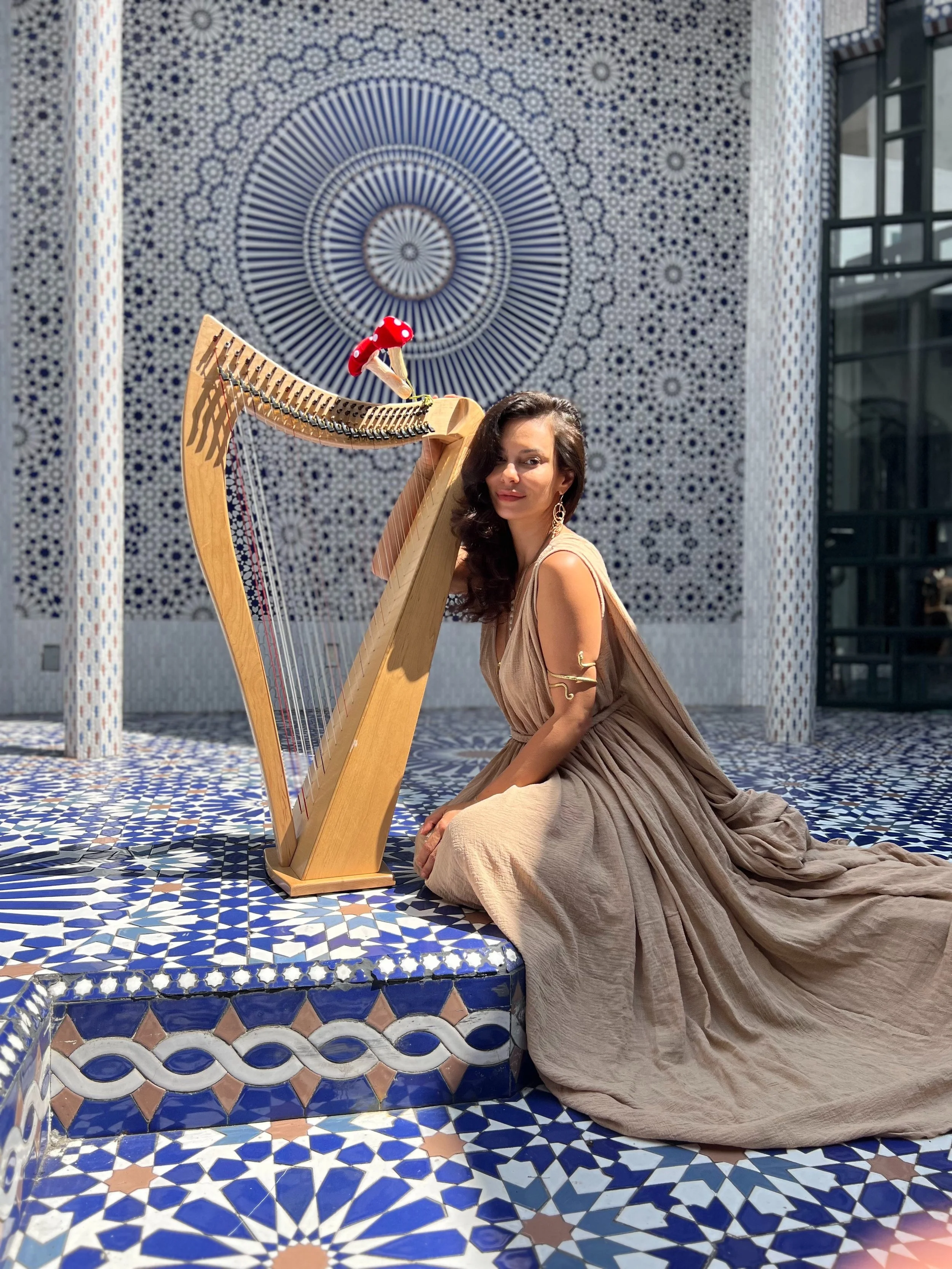
Questions worth asking.
-
Yes, this program was built for exactly this person. The curriculum begins from first principles and moves at a pace that takes complete beginners to real fluency within twelve weeks. Zero experience is the ideal starting point.
-
A 22-string lever harp or an acoustic guitar with nylon strings, a tuning app (Pano Tuner is free), and a quiet place to practice. Full gear guidance arrives with your enrollment confirmation.
-
15 to 20 minutes a day. Consistency matters more than duration. The research on adult motor skill acquisition is clear: short daily contact with your instrument outperforms long, infrequent sessions every time.
-
Every class is recorded and replay access is included with enrollment. Watching the replay before the following week’s class keeps you current with the group. Live attendance is always encouraged. The real-time energy is a meaningful part of the experience.
-
Yes. Harp meets at 11am Pacific and guitar at 12:30pm, so you can take one class or both. Most students focus on one for the deepest progress, and you are welcome to do both.
-
Yes. You can pay in full for the twelve weeks, or choose a two- or three-part plan at checkout.
-
That depends on your license, your service center, and your state’s rules, so check with them first. This program gives you the musical skill. You decide where it belongs in your practice.
-
Keep Music Human is music education. No substances are part of the program, and nothing here is medical or therapeutic advice. The skills are meant for legal, regulated care and lawful traditional settings.
Come learn the music.
Whether you hold the session or sit in it, twelve weeks from now the harp or the guitar could be in your hands. Enroll, or book a call with me and we will work out together whether this is your next step.